How to spot a lab grown diamond when you are buying
In short
- Lab grown diamonds are chemically and optically identical to mined ones. No home test separates them, and anyone claiming otherwise is selling something.
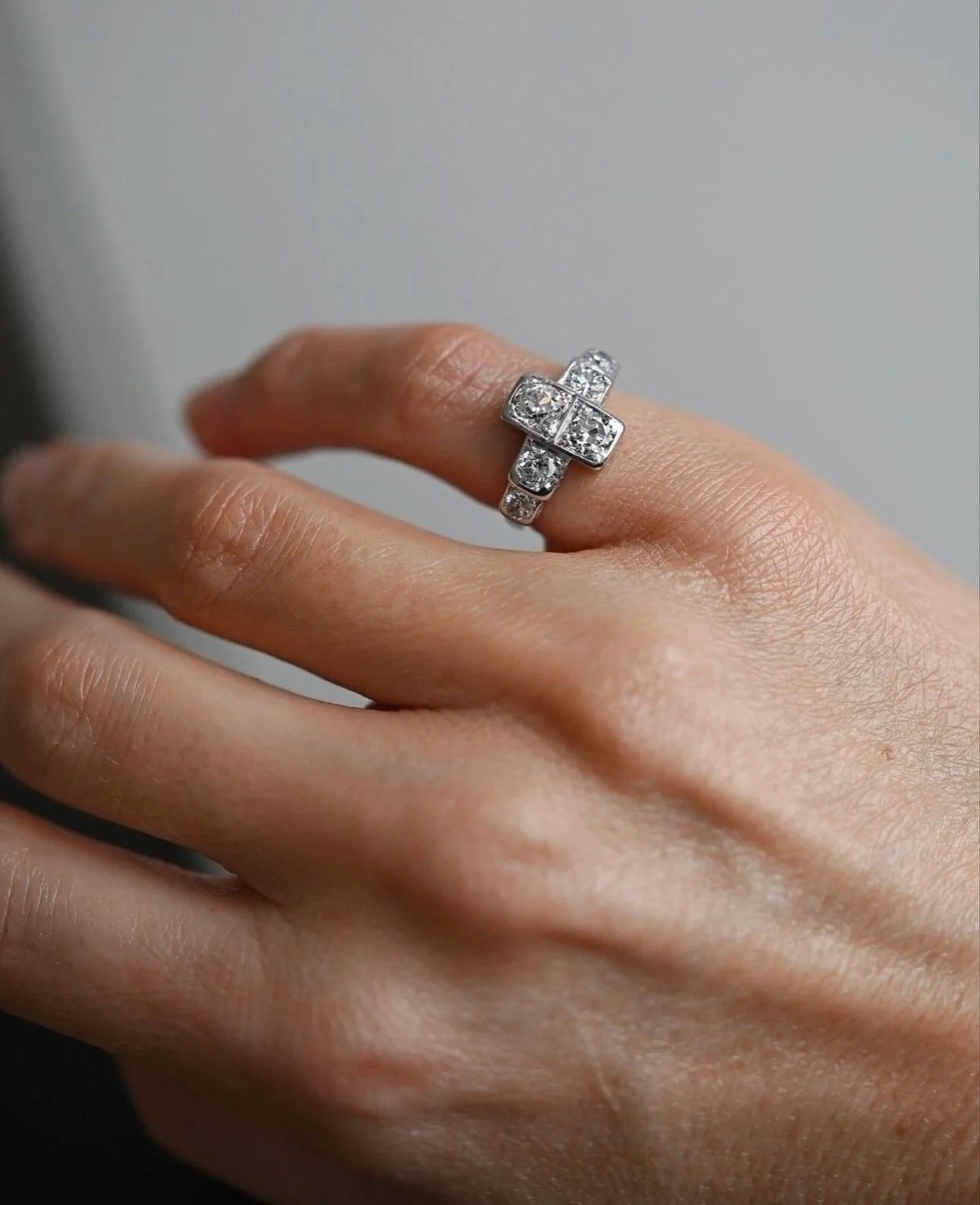
- Context does most of the work: an old cut in a period mount is mined by definition, since lab stones did not exist in gem quality until recently.
- Above meaningful sums, ask for a grading report. Laboratories identify origin routinely, and modern lab stones are usually laser inscribed.
Start with the fact that clears most of the confusion: a lab grown diamond is a diamond. It is carbon crystallised in the same structure, with the same hardness, the same refractive index and the same way of handling light. It is not cubic zirconia, it is not moissanite, and it is not fake. What it is, is cheap by comparison, and that is the only reason origin matters when you are buying.
What you cannot do
You cannot tell at home. Every property a consumer can test, sparkle, scratch resistance, thermal conductivity, the fog test, the newspaper test, is identical between the two, because the material is identical. The handheld testers sold as diamond testers measure thermal conductivity and will confirm a stone is a diamond while telling you nothing about where it grew. Some newer testers claim to screen for lab origin and they are screening tools, not conclusive ones.
Anyone who tells you they can identify a lab grown diamond by eye is either mistaken or hoping you are.
What you can do
Read the context. This is the most useful tool by a distance. Gem quality lab grown diamonds in commercial quantities are recent. Antique cuts are not. So:
| What you are looking at | What it means |
|---|---|
| Old mine or old European cut, period mount, wear consistent | Mined. The cut predates the technology |
| Rose cut in a Georgian or Victorian setting | Mined |
| Modern round brilliant in an antique mount | A replacement stone, origin unknown, ask |
| Modern brilliant, modern mount, price well below market | Quite possibly lab grown, and should be stated |
| A large flawless stone at a surprisingly low price | Ask for a report before anything else |
Look for the inscription. Most modern lab grown stones carry a laser inscription on the girdle, giving a report number and frequently the words lab grown. It needs magnification, and it is often hidden by a claw, but if the stone is unmounted or the setting is open, ask the seller for a photograph of the girdle.
Ask for the report. Grading laboratories separate origin routinely, using growth structure, fluorescence patterns and trace elements. Above any meaningful sum, a report is the answer to this whole question, and a seller who will not obtain or share one is telling you something.
Watch the price. Lab grown stones sell at a large discount to equivalent mined ones, and that discount has grown as production has scaled. A price that seems far too good for the specification usually is, and the explanation is normally origin rather than a bargain.
The disclosure question
In most markets, sellers are required to disclose lab origin, and reputable ones do it plainly. The problems arise at the edges: pieces sold privately without paperwork, stones replaced in older mounts, and descriptions that use words like created, cultured or grown without making the meaning obvious. If a description uses any of those words, it is telling you the answer.
Ask the question directly and in writing: is this stone mined or laboratory grown, and what is that based on? A good seller answers in one sentence. The answer, or the absence of one, is your evidence either way.
Why this matters for value
Buy a lab grown diamond because you want a large, bright, clean stone at a price a mined one could not reach. That is a completely rational purchase and it makes a beautiful ring.
Do not buy one expecting it to hold value. Production capacity keeps rising and prices keep falling, which is excellent for buyers and unhelpful for anyone reselling later. Mined stones, and old cut stones in particular, behave in the opposite direction, because nobody is making more of them.
That is the whole trade-off, stated honestly, and it is the same trade-off in every category where a manufactured version of a scarce thing becomes available.
Common questions
Are lab grown diamonds real diamonds?
Yes. They are crystallised carbon with the same hardness, the same refractive index and the same optical behaviour as mined diamonds. The difference is origin and price, not authenticity. They are not simulants like cubic zirconia or moissanite, which are different materials entirely.
Can I tell a lab grown diamond at home?
No, and this is the honest answer nobody selling test kits will give you. The materials are identical, so sparkle, hardness, thermal conductivity and the fog test all behave the same way. Separation requires laboratory instruments that detect growth patterns and trace elements.
How can I tell if an antique ring has a lab grown stone?
By the cut and the setting rather than the stone's chemistry. Gem quality lab diamonds are recent, so an old mine or old European cut in an untouched period mount is mined by definition. A modern brilliant sitting in a Victorian setting is a replacement, whatever its origin, and worth asking about.
Do lab grown diamonds have inscriptions?
Most modern lab grown stones carry a laser inscription on the girdle giving a report number and often the words lab grown. It needs magnification to read, so ask the seller to photograph the girdle if the stone is unmounted or the setting allows it.
Does it matter if a diamond is lab grown?
It matters for price. Lab grown stones cost a fraction of equivalent mined ones and, more importantly for a seller, they have not held their value as production has scaled. Buy one because you want a large stone cheaply; do not buy one expecting it to be an asset.
Nextmine is a marketplace for jewelry that has already had one life. Buyers pay into escrow, sellers are paid once the piece has arrived, and every listing is someone's own photographs of their own piece.
Browse the pieces for sale·How payments work·Questions and answers